



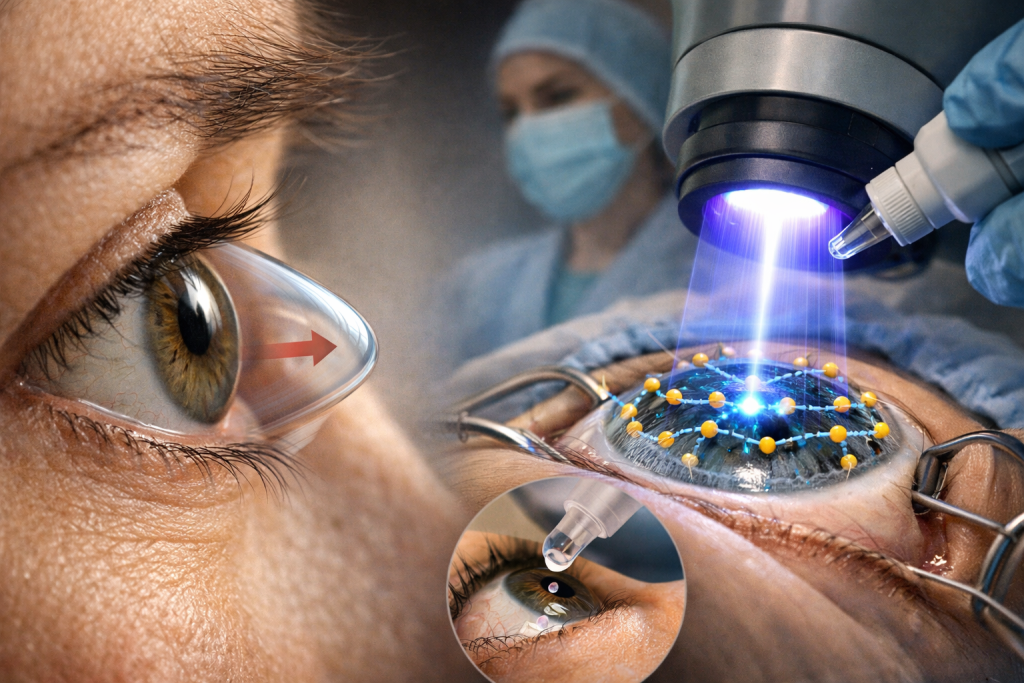
Keratoconus is a progressive eye condition that causes the cornea to thin and bulge into a cone-like shape, leading to blurred vision, increasing astigmatism, light sensitivity, and difficulty with glasses or contact lenses. Left untreated, progressive keratoconus can significantly impair vision and, in advanced cases, may require corneal transplantation. Corneal collagen cross-linking (CXL) has transformed how eye care professionals manage keratoconus by helping to slow or halt disease progression rather than simply correcting vision symptoms.
In October 2025, a major milestone was reached in keratoconus care: the U.S. Food and Drug Administration (FDA) approved the first epithelium-on (epi-on) corneal cross-linking therapy for keratoconus, known as Epioxa™. This approval represents a significant evolution in treatment options for patients and clinicians alike.
What Is Corneal Cross-Linking?
Corneal cross-linking is a minimally invasive procedure designed to strengthen the cornea. It uses riboflavin (vitamin B2) eye drops combined with controlled ultraviolet-A (UV-A) light to create new chemical bonds—called cross-links—between collagen fibers in the cornea. These additional bonds increase corneal rigidity, helping the cornea maintain its shape and resist further thinning and bulging.
It is important to note that cross-linking does not reverse keratoconus or eliminate the need for glasses or contact lenses. Instead, its primary goal is to stop or slow progression, preserving vision and reducing the likelihood of needing more invasive procedures such as corneal transplantation.
Epi-Off vs. Epi-On Cross-Linking: What’s the Difference?
Traditional FDA-Approved Epi-Off Cross-Linking
For nearly a decade, the only FDA-approved corneal cross-linking procedure in the United States was epithelium-off (epi-off) cross-linking, performed using Photrexa® riboflavin solutions and the KXL® UV system. In this approach, the outer layer of the cornea (the epithelium) is removed to allow riboflavin to penetrate deeply into the corneal tissue before UV light activation.
Epi-off cross-linking is effective and well-studied, but it is associated with postoperative pain, light sensitivity, several days of epithelial healing, and a small risk of infection or corneal haze during recovery.
FDA-Approved Epi-On Cross-Linking (Epioxa™)
In October 2025, the FDA approved Epioxa™ HD / Epioxa™, the first incision-free, epithelium-on corneal cross-linking therapy for keratoconus. Unlike traditional methods, epi-on cross-linking preserves the corneal epithelium, eliminating the need for surface removal.
Epioxa uses specially formulated, oxygen-enriched riboflavin solutions that are designed to penetrate the intact epithelium. The drops are activated with UV light in an oxygen-rich environment, allowing effective cross-linking while improving patient comfort and recovery time.
Why FDA Approval of Epi-On Cross-Linking Matters
The FDA approval of Epioxa marks a turning point in keratoconus treatment. Prior to this approval, epi-on cross-linking in the U.S. was considered investigational or off-label. Now, patients have access to an FDA-approved, clinically studied epi-on option supported by large Phase 3 clinical trials involving more than 400 patients.
Key potential benefits include less pain, faster visual recovery, lower risk of infection, and expanded access to earlier treatment.
Who Is a Candidate for Epi-On Cross-Linking?
Epioxa is approved for adults and pediatric patients aged 13 years and older with keratoconus. Candidates typically demonstrate evidence of progressive disease.
Cross-Linking, Vision Correction, and Long-Term Care
While cross-linking stabilizes the cornea, many patients still require glasses or specialty contact lenses. Early diagnosis and timely treatment remain critical.
A New Era in Keratoconus Treatment
The FDA approval of epi-on corneal cross-linking represents a significant advancement in keratoconus care.